quantmsdiann



DIA proteomics Nextflow pipeline powered by DIA-NN.
quantmsdiann is a cloud-ready Nextflow pipeline for Data-Independent Acquisition (DIA) proteomics. It leverages DIA-NN as the core engine for peptide identification and quantification, with full integration into the quantms ecosystem.
DDA users: For Data-Dependent Acquisition (LFQ, TMT/iTRAQ), use the quantms pipeline.
Workflow Overview
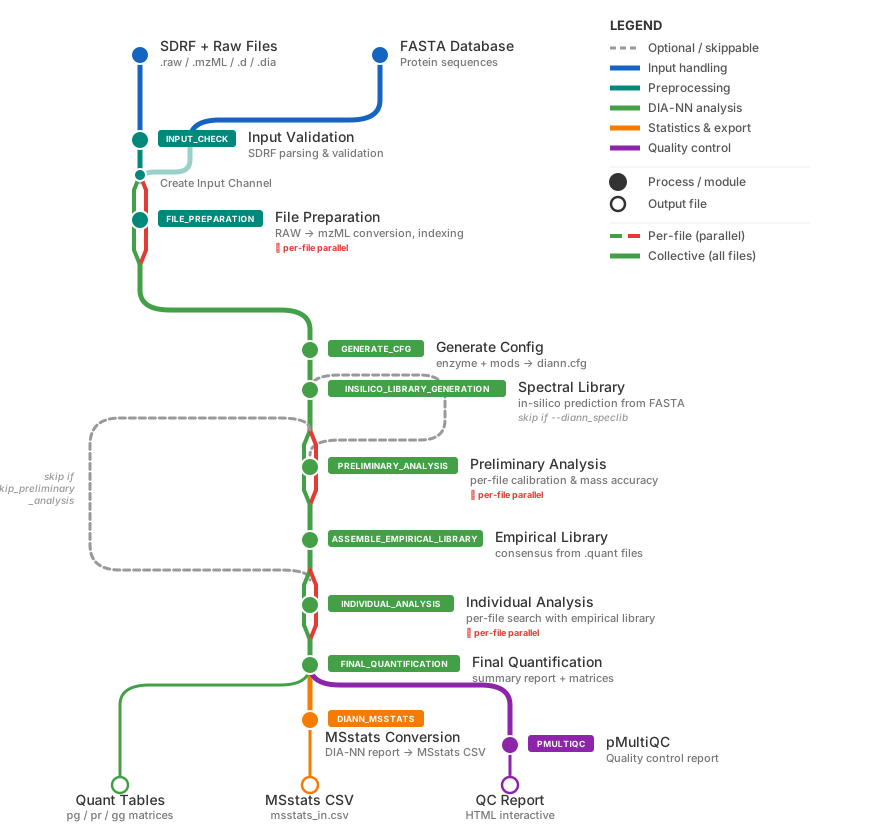
Key Features
- DIA-NN engine: Neural network-based peptide identification
- Library-free mode: No spectral library needed
- Spectral library mode: Use existing libraries for targeted analysis
- Cloud-ready: AWS, GCP, Azure, HPC, or local execution
- SDRF metadata: Standardized experiment annotation
- QPX output: Parquet-based standardized output
- Quality control: Integrated pmultiqc reports
Quick Start
# Install Nextflow
curl -s https://get.nextflow.io | bash

# Run test profile
nextflow run bigbio/quantmsdiann \
    -profile test_dia,docker \
    --outdir results/

# Run with your data
nextflow run bigbio/quantmsdiann \
    -profile docker \
    --input experiment.sdrf.tsv \
    --database uniprot_human.fasta \
    --outdir results/
DIA vs DDA
| Feature | DIA (quantmsdiann) | DDA (quantms) |
|---|---|---|
| Precursor selection | All ions in window | Top-N individual ions |
| Reproducibility | Very high | Moderate |
| Missing values | Few | Common |
| Typical proteins | 6,000-10,000 | 3,000-8,000 |
| Engine | DIA-NN | Comet, MS-GF+ |
| Best for | Large cohorts, clinical | Discovery, TMT |
Citation
Dai C, Pfeuffer J, Wang H, et al. quantms: a cloud-based pipeline for quantitative proteomics. Nature Methods. 2024;21:1603-1607. DOI: 10.1038/s41592-024-02343-1
Demichev V, et al. DIA-NN: neural networks and interference correction enable deep proteome coverage. Nature Methods. 2020;17:41-44. DOI: 10.1038/s41592-019-0638-x
Ecosystem
| Tool | Description |
|---|---|
| quantms | DDA proteomics pipeline |
| mokume | Protein quantification library |
| qpx | Data format conversion |
| pmultiqc | Interactive QC reporting |
| portal.quantms.org | Browse reanalyzed datasets |